One of the concepts that you may have learned about in school was the food web. If your memory is a little hazy, think of it as more of a 2-dimensional food chain. A food chain is a linear sequence of who eats who in an ecosystem. A food web recognizes that there may be multiple types of predators and prey in an ecosystem and it helps to provide a visual representation of these interactions.

In a healthy ecosystem, the populations of each individual species remains relatively constant over long periods of time. Of course, if you look at the predator-prey relationship, you will see slight differences but when looking in the short term, but when looking at the bigger picture we see a cyclical relationship.
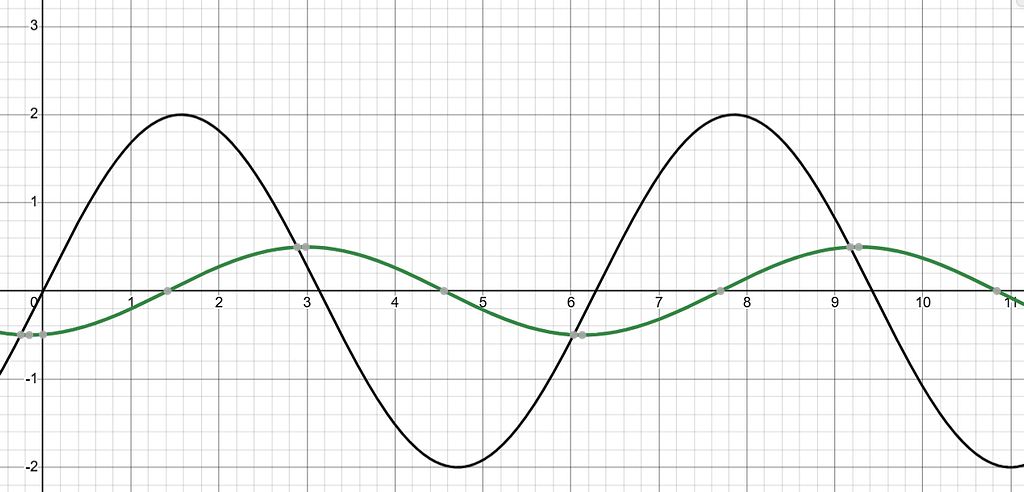
Consider the graph shown above which is something I quickly threw together in Desmos to show a general relationship between predator and prey (like wolves and rabbits). The blue line represents the prey in the relationship. As the amount of prey increases, the amount of predators (green line) increases because there is an increased food supply. As the amount of predators increases, the amount of prey will decrease because the predators will consume more of the prey.
Consider a food web that we remove the apex predator. In polar regions, grey wolves may be considered the apex, or top, predator. Looking back at history, we can see that ranchers decimated the wolf population because they didn’t like their livestock being eaten.

What will happen when our wolf friends are removed from the food web? Their prey, such as deer, will be able to increase in numbers until they reach the carrying capacity of their ecosystem. In other word, they run out of food. As the deer population increases, we will see a decrease in the population of plants such as tree saplings. This process is known as a trophic cascade. It is also known as a top-down control. By removing the top of the food web, the whole web is affected. The loss of saplings diminishes the health and biodiversity of the ecosystem. We need our ecosystem to be balanced for it to be healthy.
Wolf Reintroduction Changes Ecosystem in Yellowstone
Our global society can be compared to this concept of a food web. We are connected globally whether we like it or not. Think about what you had for breakfast. If you had coffee, it may have been grown in Colombia. If you ate a banana, it have have been grown in Ecuador. The wheat in your cereal may have come from Canada. Your cell phone that is in your hand as you eat has materials from more than 20 countries.
Where Does Our Food Come From?
This global trade is vital for virtually every economy on Earth. The chart below shows what percentage of the gross domestic product (GDP) imports and exports makes up across the world.
This interconnected trade network can be a good thing because different countries have different materials, skills, and specialties. Unfortunately there is a dark side of trade as well. Manufacturing is found in certain countries because their workers are not paid well and/or may work under horrific conditions. The processing of materials that pollutes the most is often found in poorer countries as well. Business Insider’s Youtube page has many informative videos on this topic if you are interested.

Our global society goes beyond our material wants and needs though. We all share this planet. Our atmosphere, our weather, our pollutants don’t know about our arbitrary borders our nations have set. To solve the problems facing society today we need to all work together. What may work for one nation may not work for another. We need the perspectives of different cultures. We need to bring even the smallest nations to the table. Sadly, when we need to work together the most, many nations are moving further away from this vital partnership. We must not give up and we must ensure that we continue to progress towards reducing inequities around the world. Nobody should be forced to have poor health outcomes, a lack of education, no access to clean drinking water, and equal rights because they just happen to have been born on a different piece of Earth’s surface than someone else.
Associated UN Sustainable Development Goals
Goal #12: Responsible Consumption and Production
Goal #16: Peace, Justice, and Strong Institutions
Goal #17: Partnerships for the Goals